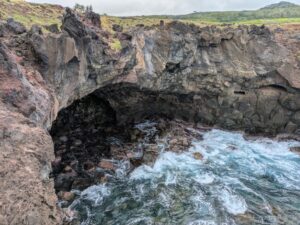
Rapa Nui is the local name of the island, the people and the language.
So the locals on Rapa Nui are the Rapa Nui, speaking Rapa Nui.
Globally the island is better known as Easter Island.
It is also one of the most remote inhabited places on earth, with the next inhabited location being Pitcairn Island, housing around 50 residents, 2075km to the West.
I remember drawing sketches of the stone head statues in school when I was a kid. They always emitted kind of an otherworldly vibe, with their intricate masonry work and the many unanswered questions when they were unearthed.
The little bit of information I either never knew or had forgotten in the meantime was that Easter Island is a special territory of Chile, part of the Valparaiso region. So, if you want to visit the island, you have to fly via Santiago de Chile anyway – what a coincidence that I’m already in the area. Might as well pay them a quick visit…
The preparation for the trip started in Mendoza, Argentina already, as travelling to the island comes with a set of prerequisites:
1. Proof of accomodation
2. Proof of a return flight within 30 days
3. Entering the above information into an entry form
Finding acceptable dates for the flights was the most difficult part, as it is very much high season now and the price of the tickets is anything but cheap at the best of times but also fluctuate €200,- up or down between one day and another.
On top of that, my credit card kept getting declined because of suspicion of fraudulent payments and it took me 2 days of transferring money back and forth between different accounts before finally finding a carrier that accepted PayPal.
With that taken care of, I just needed accomodation and the entry form, which was a walk in the park compared to sorting out the flights.
As it is going to be used from now on, here’s some information regarding the naming of the statues and locations:
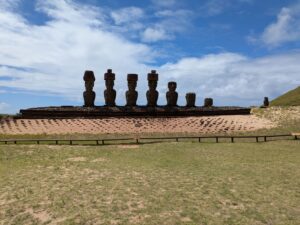
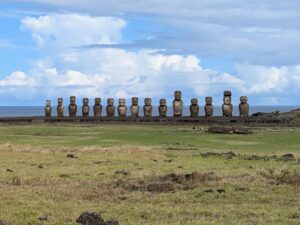
Ahu is the stone platform that serves as a base for the Moai, which is the name for the statues themselves. So there’s multiple Ahus on the island, each containing one or more Moais.
The largest one being Ahu Tongariki, consisting of 15 Moais in amazing shape.
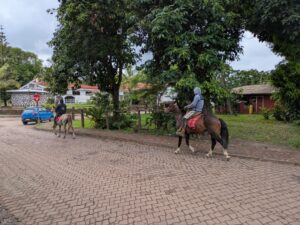
Once on the island and settled in to my accomodation, I set out on a little discovery walk to get my bearings in the captial, Hanga Roa.
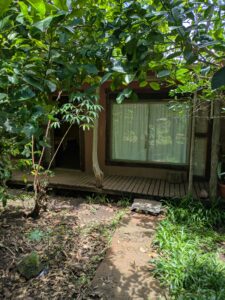
My host, Matias, built the Cabanas himself some 20 years ago and also used to be a tour guide. Nowadays, at 62 years of age, he mainly likes to drink beers and talk to his guests about anything related to Rapa Nui that they’re interested in – free tour guide information!
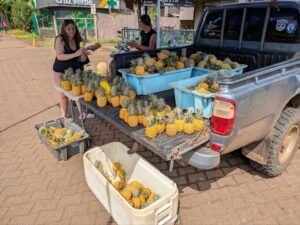
As the only town on the island, Hanga Roa is the central hub for restaurants, activities and errands in general. At first, figuring out how to visit the Moai and getting around on the island seemed even more complicated than booking the flight.
In short:
– You need an entrance ticket for the Rapa Nui National Park that covers most of the island and most of the sites
– You need an officially licensed tour guide
– You need transportation for you and your guide
You could also book one of the many tours offered, either half or full day, but you’d still need to pay extra for the entrance ticket.
I decided against the entrance ticket and the guide because there are some sites that are not part of the national park and could be visitied for free, including the ones I was most interested in.
So I rented a scooter and set out to discover the island on my own.
With a size of only 164m², it is really easy to get across the whole island multiple times a day, if that’s what you wanted.
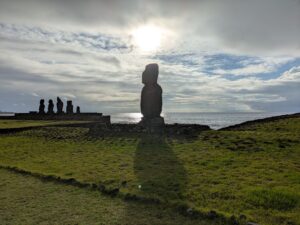
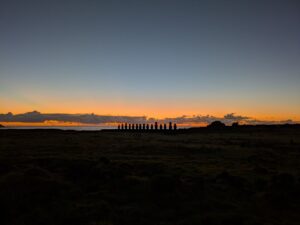
What that allows you to do, is to get up early in the morning to drive to Ahu Tongariki in the northeast for an amazing sunrise, spend the whole day just driving around and see an equally amazing sunset at Ahu Tahai in the southwest in the evening of the same day. Which is what I did.
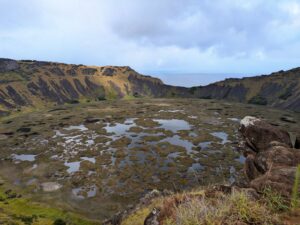
I also went to the summit of the extinct volcano Rano Kau, where you can see the remnants of an old settlement, built in the 18th century and hike around the crater rim. The crater now serves some stunning views and also one of the 3 lakes on the island.
As it is tradition during my travels, I quickly set out to get a tattoo done by a local tattoo artist, painter, photographer and dancer, who also told me about the local dinner and dance show “Kari Kari”, in which he is dancing one of the main parts.
Visiting romantic dinner and dance shows by myself is one of my hobbies, so obviously I agreed.
What I learned from my host Matias is, that the Rapa Nui and the Maori culture from New Zealand share a lot of similarities, as they all originated in the same area around French Polynesia, so seeing the cultural dance reminded me very much of dances I’ve seen performed by Maori.
As the Kari Kari performance took place on my last evening on the island, it was a fitting farewell after spending 5 days on this remote gem of an island.
There’s so much more that I could write about Rapa Nui and my experiences there, but most of it would be repetitive and revolving around the same basic principle:
Rapa Nui is an amazing island with outstanding places and views and the most relaxed inhabitants I’ve seen in a very long time.